Import stuff & Load dataset
import tensorflow as tf
import keras
from keras import backend as K
import numpy as np
%matplotlib inline
import matplotlib.pyplot as plt
print(tf.__version__)
print(keras.__version__)
import cv2  # for image processing
from sklearn.model_selection import train_test_split
import scipy.io
import os
import tarfile
import keras_utils
from keras_utils import reset_tf_session
Dataset was downloaded for you, it takes 12 min and 400mb. Relevant links (just in case):
- http://www.robots.ox.ac.uk/~vgg/data/flowers/102/index.html
- http://www.robots.ox.ac.uk/~vgg/data/flowers/102/102flowers.tgz
- http://www.robots.ox.ac.uk/~vgg/data/flowers/102/imagelabels.mat
# we will crop and resize input images to IMG_SIZE x IMG_SIZE
IMG_SIZE = 250

def decode_image_from_raw_bytes(raw_bytes):

    img = cv2.imdecode(np.asarray(bytearray(raw_bytes), dtype=np.uint8), 1)
    img = cv2.cvtColor(img, cv2.COLOR_BGR2RGB)

    return img

def image_center_crop(img):
    """
    Makes a square center crop of an img, which is a [h, w, 3] numpy array.
    Returns [min(h, w), min(h, w), 3] output with same width and height.
    For cropping use numpy slicing.
    """

    h, w = img.shape[0], img.shape[1]
    length = min(h, w)

    h_start = h//2 - length//2
    h_end = h_start + length
    w_start = w//2 - length//2
    w_end = w_start + length

    cropped_img = img[h_start:h_end, w_start:w_end, ] ### YOUR CODE HERE

    # checks for errors
    h, w, c = img.shape
    assert cropped_img.shape == (min(h, w), min(h, w), c), "error in image_center_crop!"

    return cropped_img

def prepare_raw_bytes_for_model(raw_bytes, normalize_for_model=True):

    img = decode_image_from_raw_bytes(raw_bytes)  # decode image raw bytes to matrix
    img = image_center_crop(img)  # take squared center crop
    img = cv2.resize(img, (IMG_SIZE, IMG_SIZE))  # resize for our model

    if normalize_for_model:

        img = img.astype("float32")  # prepare for normalization
        img = keras.applications.inception_v3.preprocess_input(img)  # normalize for model

		return img

# reads bytes directly from tar by filename (slow, but ok for testing, takes ~6 sec)
def read_raw_from_tar(tar_fn, fn):

    with tarfile.open(tar_fn) as f:

        m = f.getmember(fn)

        return f.extractfile(m).read()

# test cropping
raw_bytes = read_raw_from_tar("102flowers.tgz", "jpg/image_00001.jpg")

img = decode_image_from_raw_bytes(raw_bytes)
print(img.shape)
plt.imshow(img)
plt.show()

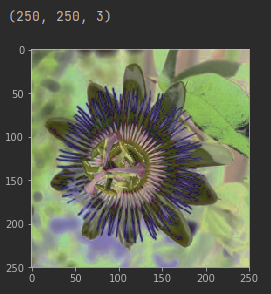
img = prepare_raw_bytes_for_model(raw_bytes, normalize_for_model=False)
print(img.shape)
plt.imshow(img)
plt.show()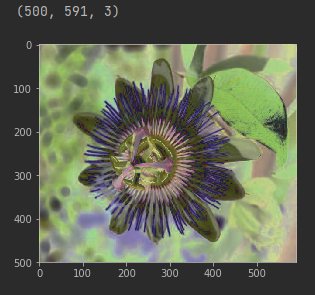
Prepare for Training
# read all filenames and labels for them

# read filenames firectly from tar
def get_all_filenames(tar_fn):

    with tarfile.open(tar_fn) as f:

        return [m.name for m in f.getmembers() if m.isfile()]

def raw_generator_with_label_from_tar(tar_fn, files, labels):
    label_by_fn = dict(zip(files, labels))
    with tarfile.open(tar_fn) as f:
        while True:
            m = f.next()
            if m is None:
                break
            if m.name in label_by_fn:
                yield f.extractfile(m).read(), label_by_fn[m.name]

all_files = sorted(get_all_filenames("102flowers.tgz"))  # list all files in tar sorted by name
all_labels = scipy.io.loadmat('imagelabels.mat')['labels'][0] - 1  # read class labels (0, 1, 2, ...)

# all_files and all_labels are aligned now
N_CLASSES = len(np.unique(all_labels))
print(N_CLASSES)

# split into train/test
tr_files, te_files, tr_labels, te_labels = \
    train_test_split(all_files, all_labels, test_size=0.2, random_state=42, stratify=all_labels)
# batch generator
BATCH_SIZE = 32
def batch_generator(items, batch_size):
"""
Implement batch generator that yields items in batches of size batch_size.
There's no need to shuffle input items, just chop them into batches.
Remember about the last batch that can be smaller than batch_size!
Input: any iterable (list, generator, ...). You should do `for item in items: ...`
In case of generator you can pass through your items only once!
Output: In output yield each batch as a list of items.
"""
mini_batch = []
for item in items:
if len(mini_batch) < batch_size:
mini_batch.append(item)
else:
yield mini_batch
mini_batch=[]
mini_batch.append(item)
yield mini_batch
def train_generator(files, labels):
while True: # so that Keras can loop through this as long as it wants
for batch in batch_generator(raw_generator_with_label_from_tar(
"102flowers.tgz", files, labels), BATCH_SIZE):
# prepare batch images
batch_imgs = []
batch_targets = []
for raw, label in batch:
img = prepare_raw_bytes_for_model(raw)
batch_imgs.append(img)
batch_targets.append(label)
# stack images into 4D tensor [batch_size, img_size, img_size, 3]
batch_imgs = np.stack(batch_imgs, axis=0)
# convert targets into 2D tensor [batch_size, num_classes]
batch_targets = keras.utils.np_utils.to_categorical(batch_targets, N_CLASSES)
yield batch_imgs, batch_targets
for _ in train_generator(tr_files, tr_labels):
print(_[0].shape, _[1].shape)
plt.imshow(np.clip(_[0][0] / 2. + 0.5, 0, 1))
break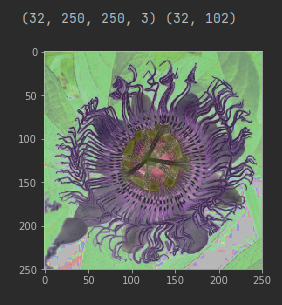
Training (transfer learning)
https://keras.io/api/applications/inceptionv3/
def inception(use_imagenet=True):

    # load pre-trained model graph, don't add final layer
    model = keras.applications.InceptionV3(include_top=False, input_shape=(IMG_SIZE, IMG_SIZE, 3), weights='imagenet' if use_imagenet else None)

    # add global pooling just like in InceptionV3
    new_output = keras.layers.GlobalAveragePooling2D()(model.output)

    # add new dense layer for our labels
    new_output = keras.layers.Dense(N_CLASSES, activation='softmax')(new_output)
    model = keras.engine.training.Model(model.inputs, new_output)

    return model

model = inception()
model.summary()

# how many layers our model has (313)
print(len(model.layers))
# set all layers trainable by default
for layer in model.layers:
layer.trainable = True
if isinstance(layer, keras.layers.BatchNormalization):
# we do aggressive exponential smoothing of batch norm
# parameters to faster adjust to our new dataset
layer.momentum = 0.9
# fix deep layers (fine-tuning only last 50)
for layer in model.layers[:-50]:
# fix all but batch norm layers, because we neeed to update moving averages for a new dataset!
if not isinstance(layer, keras.layers.BatchNormalization):
layer.trainable = False# compile new model
model.compile(
loss='categorical_crossentropy', # we train 102-way classification
optimizer=keras.optimizers.adamax(lr=1e-2), # we can take big lr here because we fixed first layers
metrics=['accuracy'] # report accuracy during training
)
# we will save model checkpoints to continue training in case of kernel death
model_filename = 'flowers.002.hdf5'
last_finished_epoch = 16
#### uncomment below to continue training from model checkpoint
#### fill `last_finished_epoch` with your latest finished epoch
from keras.models import load_model
s = reset_tf_session()
last_finished_epoch = 16
model = load_model(model_filename.format(last_finished_epoch))
# fine tune for 2 epochs (full passes through all training data)
# we make 2*8 epochs, where epoch is 1/8 of our training data to see progress more often
model.fit_generator(
train_generator(tr_files, tr_labels),
steps_per_epoch=len(tr_files) // BATCH_SIZE // 8,
epochs=2 * 8,
validation_data=train_generator(te_files, te_labels),
validation_steps=len(te_files) // BATCH_SIZE // 4,
callbacks=[keras_utils.TqdmProgressCallback(),
keras_utils.ModelSaveCallback(model_filename)],
verbose=0,
initial_epoch=last_finished_epoch or 0
)