This model introduces issues.
- Proof-of-Work requires all the nodes to solve complex mathematical problems, which consume an enormous amount of energy.
- It has a very high time to finality and a low throughput. In the case of Bitcoin, a new block is produced every 10 minutes by design. It’s safe to wait 3-6 block confirmations—around 30 to 60 minutes—before considering a transaction finalized. In Classical consensus systems, a transaction is considered final within seconds.
To prevent fraudulent transactions, blockchain requires miners (computers that take part in helping calculate hashes) to solve a crypto puzzle - a bunch of miners start solving the puzzle and whoever solves it first wins the transaction fees for that block - (essentially calculate a hash that starts with X number of 0’s) which takes time, so the bad person can’t insert a lot of bad blocks in the blockchain since each one takes some time to solve the puzzle (and computing power).
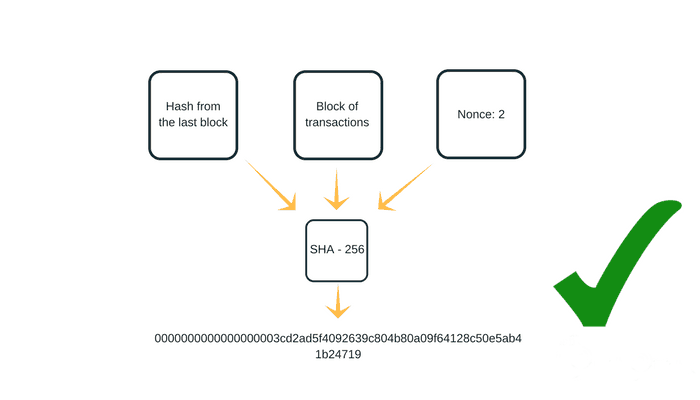
Solving this puzzle (having a hash with X number of 0’s) is how a miner shows their “proof of work”. Now this concept/algorithm has some issues since it favors miners with more computing power (and specialized equipments to calculate the hash faster), essentially wasting a lot of power.
PoW Caveats
PoW mechanism is not environmentally-friendly and makes inefficient energy consumption. Another problem is the inability to scale which results from the fact that the ledger needs to be replicated among all the nodes to reach consensus, and this requires approximately 10 minutes in the Bitcoin blockchain, making it unsuitable for applications that require instant finality and high throughput.
Smart contracts are not scalable in linear and synchronous blockchains such as Bitcoin or Ethereum because in those blockchains every single node is needed to arrive at consensus which would render the network impractical for decentralized application that require high throughput and fast finality while being able to scale globally.
51% Attack
A lot of miners get together in a “mining pool” and whenever one of them solves and wins the puzzle, they share the prize with other miners in the pool, now on the surface this doesn’t sound so bad since you’re just sharing the prize, but if a pool gets big enough, it can have 51% share in a blockchain and can do some serious damage through 51% attack - this also defeats the purpose of being “decentralized” if one large pool can control all the transactions.
Proof of Stake (vs Proof of Work)
To solve these shortcomings of the Proof of Work algorithm, another algorithm was proposed called Proof of Stake. This solves the problem of not wasting so much electricity compared to Proof of Work since many miners spend time and power solving the puzzle but only one answer is used rest of the miners’ work is thrown away - waste of power. Another problem this solves is it’s very very hard to get 51% stake in the network since it will require enormous “security deposit”.