Breaking Secure Boot on Google Nest Hub (2nd Gen) to run Ubuntu
Riscure fault injection and secure boot bypass techniques

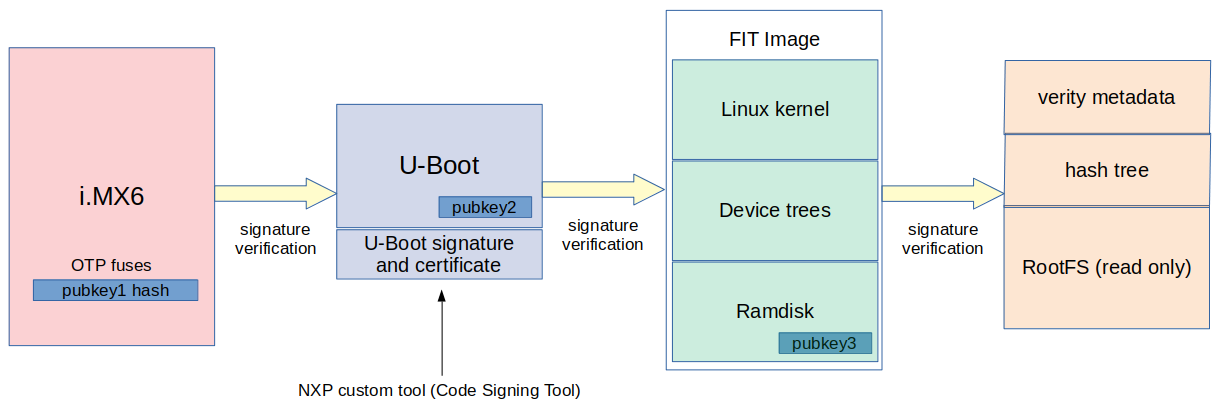
Everything starts in the ROM code inside the SoC. On NXP iMX6, there is a hardware component called High Assurance Boot (HAB) that it is able to validate the signature of the first stage bootloader, making it possible to implement a secure boot process. The High Assurance Boot inside iMX6 devices can also be called the Root of Trust, since if it is compromised, all the secure boot process is also compromised.
The ROM code inside the iMX6 SoC, using the HAB component, will check the signature of the bootloader. For that, it is necessary to generate a pair of keys (public and private), sign the bootloader with the private key and store the public key inside the SoC. On iMX6, OTP fuses are used to store the keys. Actually, to make it less expensive, only the hash of the public key is stored in the SoC.
When the bootloader boots (e.g. U-Boot), it will have to check the signature of the Linux kernel. For that, it is common to use an image format called FIT image. The FIT image is a container for multiple binaries with hashing and signature support, and usually contains the Linux kernel image, device tree files and an initial ramdisk. After generating a pair of keys, we need to sign the binaries inside the FIT image with the private key e configure U-Boot to use the public key to check the signature of the FIT image.
After the kernel boots, it will run the init program from the ramdisk image. The ramdisk will have the logic to verify the integrity of the final root filesystem before mounting it. There are some options to implement this. One common option is using the device-mapper verity (dm-verity) kernel module. The dm-verity kernel module provides integrity checking of block devices and requires a read-only rootfs (squashfs can be a good solution). Other approaches would be IMA or dm-integrity if you want a read-write root filesystem.
Here is a diagram of the complete secure boot process:
Secure boot vulnerabilities in the ROM code of several NXP devices (i.MX6, i.MX50, i.MX53, i.MX7, i.MX28 and Vybrid families) were publicly disclosed on July 17th, 2017. And if your chain of trust is compromised, everything is compromised! So we need to be aware of these types of vulnerabilities (in this case, they were fixed with new silicon).
While secure boot ensures authenticity and integrity, it does not protect the device from being counterfeited or threat actors from extracting code/data from the device. So if you want to protect your intellectual property or ensure data confidentiality, you will need to use encryption.
https://sergioprado.blog/introduction-embedded-linux-security-part-1/