https://blog.brownplt.org/2023/09/17/rust-ownership.html
*Ownership *is a set of rules that govern how a Rust program manages memory
Some languages have garbage collection that regularly looks for no-longer-used memory as the program runs;
Rust uses a third approach: memory is managed through a system of ownership with a set of rules that the compiler checks. If any of the rules are violated, the program won’t compile. None of the features of ownership will slow down your program while it’s running.
First, let’s take a look at the ownership rules. Keep these rules in mind as we work through the examples that illustrate them:
- Each value in Rust has an owner.
- There can only be one owner at a time.
- When the owner goes out of scope, the value will be dropped.
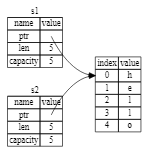
To ensure memory safety, after the line let s2 = s1;, Rust considers s1
as no longer valid. Therefore, Rust doesn’t need to free anything when s1
goes out of scope. Check out what happens when you try to use s1
after s2 is created; it won’t work:
let s1 = String::from("hello");
let s2 = s1;

println!("{}, world!", s1);
$ cargo run
Compiling ownership v0.1.0 (file:///projects/ownership)
error[E0382]: borrow of moved value: `s1`
--> src/main.rs:5:28
|
2 | let s1 = String::from("hello");
| -- move occurs because `s1` has type `String`, which does not implement the `Copy` trait
3 | let s2 = s1;
| -- value moved here
4 |
5 | println!("{}, world!", s1);
| ^^ value borrowed here after move
|
= note: this error originates in the macro `$crate::format_args_nl` which comes from the expansion of the macro `println` (in Nightly builds, run with -Z macro-backtrace for more info)
For more information about this error, try `rustc --explain E0382`.
error: could not compile `ownership` due to previous errorWhen we assign s1 to s2, the String data is copied, meaning we copy the pointer, the length, and the capacity that are on the stack. We do not copy the data on the heap that the pointer refers to.
If we *do *want to deeply copy the heap data of the String, not just the stack data, we can use a common method called clone
Here’s an example of the clone method in action:
let s1 = String::from("hello");
let s2 = s1.clone();

println!("s1 = {}, s2 = {}", s1, s2);
But, if the variable is stored on stack (have a known size at compile time), there are no problem in copying/reassigning it:
let x = 5;
let y = x;

println!("x = {}, y = {}", x, y);
Rust has a special annotation called the Copy trait that we can place on types that are stored on the stack, as integers are. If a type implements the Copy trait, variables that use it do not move, but rather are trivially copied, making them still valid after assignment to another variable.
The same is true for functions, passing a variable to a function will move OR copy
fn main() {
    let s = String::from("hello");  // s comes into scope

    takes_ownership(s);             // s's value moves into the function...
                                    // ... and so is no longer valid here

    let x = 5;                      // x comes into scope

    makes_copy(x);                  // x would move into the function,
                                    // but i32 is Copy, so it's okay to still
                                    // use x afterward

} // Here, x goes out of scope, then s. But because s's value was moved, nothing
  // special happens.

fn takes_ownership(some_string: String) { // some_string comes into scope
    println!("{}", some_string);
} // Here, some_string goes out of scope and `drop` is called. The backing
  // memory is freed.

fn makes_copy(some_integer: i32) { // some_integer comes into scope
    println!("{}", some_integer);
} // Here, some_integer goes out of scope. Nothing special happens.
If we tried to use s after the call to takes_ownership, Rust would throw a compile-time error.
REFERENCES:
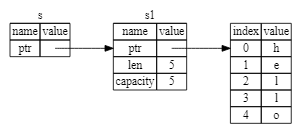
Here is how you would define and use a calculate_length function that has a reference to an object as a parameter instead of taking ownership of the value:
fn main() {
    let s1 = String::from("hello");

    let len = calculate_length(&s1);

    println!("The length of '{}' is {}.", s1, len);
}

fn calculate_length(s: &String) -> usize {
    s.len()
}
But this turns the **s** inside **change()** immutable!
fn main() {
    let s = String::from("hello");

    change(&s);
}

fn change(some_string: &String) {
    some_string.push_str(", world");
}
$ cargo run
Compiling ownership v0.1.0 (file:///projects/ownership)
error[E0596]: cannot borrow `*some_string` as mutable, as it is behind a `&` reference
--> src/main.rs:8:5
|
7 | fn change(some_string: &String) {
| ------- help: consider changing this to be a mutable reference: `&mut String`
8 | some_string.push_str(", world");
| ^^^^^^^^^^^^^^^^^^^^^^^^^^^^^^^ `some_string` is a `&` reference, so the data it refers to cannot be borrowed as mutable
For more information about this error, try `rustc --explain E0596`.
error: could not compile `ownership` due to previous errorJust as variables are immutable by default, so are references. We’re not allowed to modify something we have a reference to.
But we can fix that:
fn main() {
    let mut s = String::from("hello");

    change(&mut s);
}

fn change(some_string: &mut String) {
    some_string.push_str(", world");
}
Mutable references have one big restriction: if you have a mutable reference to a value, you can have no other references to that value. This code that attempts to create two mutable references to s will fail:
let mut s = String::from("hello");

let r1 = &mut s;
let r2 = &mut s;

println!("{}, {}", r1, r2);
$ cargo run
Compiling ownership v0.1.0 (file:///projects/ownership)
error[E0499]: cannot borrow `s` as mutable more than once at a time
--> src/main.rs:5:14
|
4 | let r1 = &mut s;
| ------ first mutable borrow occurs here
5 | let r2 = &mut s;
| ^^^^^^ second mutable borrow occurs here
6 |
7 | println!("{}, {}", r1, r2);
| -- first borrow later used here
For more information about this error, try `rustc --explain E0499`.
error: could not compile `ownership` due to previous errorThe benefit of having this restriction is that Rust can prevent data races at compile time. A data race is similar to a race condition and happens when these three behaviors occur:
- Two or more pointers access the same data at the same time.
- At least one of the pointers is being used to write to the data.
- There’s no mechanism being used to synchronize access to the data.
But this is ok tho:
let r1 = &s; // no problem
let r2 = &s; // no problem
Note that a reference’s scope starts from where it is introduced and continues through the last time that reference is used, so this also works:
let mut s = String::from("hello");

let r1 = &s; // no problem
let r2 = &s; // no problem
println!("{} and {}", r1, r2);
// variables r1 and r2 will not be used after this point

let r3 = &mut s; // no problem
println!("{}", r3);