This was my first contact with this idea:
Followed by this comment thread:
@l.uccubus : STOP 👏🏻 ROMANTICISING 👏🏻 THE 👏🏻MEANS 👏🏻 OF 👏🏻 HUMAN 👏🏻 EXTINCTION @eleolen: if you think I am romanticizing AI in this video you missed the point. I am romanticizing the art making process and artists @l.uccubus: you are. You definitely are. You think is a matter of shifting out view and interconnecting it with esoteric and holistic systems. You are comparing it with spiritual practices. If you think you are not, you are at the very least being very intellectually dishonest. @l.uccubus: I know how to think rizomathically. I have read deleuze and guattari. I use digital media in my art and ally it with the type of image and symbolic consumption in the age of social media and the internet. I think like this, and yet I think it is very ridiculous that people are constantly reinforcing the use of generative AI, especially in the art market, since artists think since Duchamp that the artist is the person with the idea, not necessarily the one who manually makes the material object. But we live in the time of contemporary art, the way in which you produce your idea is the idea itself. The medium IS THE MESSAGE. So if you are becoming one with this sycophantic LLMs you are a shallow racist homophobic mysogonist thinker. Because that “neural” information framework is deeply chauvinistic and not capable of criticizing itself. If you think that the environment can die even faster by the hands of this technology because it is just a new reality, and not being strictly against it, you just don’t care about the world, but only about it in conceptual realm. @eleolen: you know this is actually a fair point, my claim can come across as such. i will have to rethink the way i formulate this thought, and will take more time to do some reading on the matter. the thing is that i am much more interested in thinking and making sense than in AI and the whole debate about this.
Every transformative technology has demanded a new way of thinking. Writing reorganized thought as much as it preserved it.
A library organizes knowledge through categories. An encyclopedia organizes it alphabetically. A database organizes it through fields. Latent space organizes knowledge through relationships — an immensely high-dimensional landscape in which every image, sentence, metaphor, memory, emotion, scientific principle, and work of art occupies a position defined by its relations to everything else. Distance becomes resemblance. Direction becomes transformation. Every concept is a coordinate in a living field of possibility.
That is the cognitive shift latent space invites. We stop asking what is this? and begin asking toward what does this point? Every photograph becomes an address within an invisible conceptual landscape. Every thought acquires neighbors it never knew it had. Every metaphor becomes navigable. Intelligence starts to resemble topology more than taxonomy.
What matters most in latent space is how something relates. Alfred North Whitehead arrived at this conclusion a century early. Reality, he argued, is composed of processes and relations; a “thing” is an abstraction we perform upon a web of connection — what he called the fallacy of misplaced concreteness. Latent space is Whitehead’s ontology rendered operational.
Suppose someone asked about Ana and me. Rather than compressing the connection into a single noun, you could describe the dimensions along which we meet: shared imaginative play; fascination with emerging technology; mutual recognition as outsiders; delight in speculative thinking; aesthetic resonance; intellectual trust; childlike curiosity; humor; attraction; freedom without possession. No single dimension defines the relationship. Together they generate its unique position within a multidimensional landscape.
Categories keep their value — the point is complement, never abolition. But latent space offers a language of gradients instead of binaries, neighborhoods instead of boxes, topology instead of taxonomy. The world becomes less like a filing cabinet and more like a living ecosystem of correspondences. Meaning stops residing inside isolated things and starts emerging from the invisible architecture of their relationships. Perhaps that is the deepest cognitive gift this medium has to offer: a new way of asking questions.
The relationship is a coordinate. And a coordinate carries far more information than a noun. Everything Is Relations
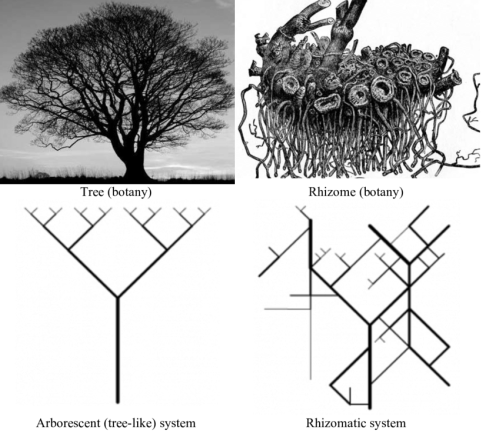
As a post-structuralist, Deleuze was occupied with dismantling old forms of knowledge that had dominated Western philosophy since the ancient Greeks – particularly the legacy of Plato’s Idealism. Platonic Idealism holds that every object in the world can be understood as striving towards a corresponding abstract “ideal” version of itself existing outside of space and time. For example, although chairs can vary in shape, colour, and size, what unites them is that they all strive towards an inner essence of chairness that makes them a chair, rather than something else.
Rhizomatic thinking understands objects through their relative difference to other objects: the colour green, for example, is not understood as striving towards an abstract greenness, but instead by how it differs from red or yellow. This emphasises a heterogeneous colour theory, insisting that the more difference two objects have from one another, the more can be understood about them – a breeding ground for innovation.
Although rhizomes pre-date the internet age, some of the most significant ways we approach the mountains of information on the web is via rhizomatic structures. The core aim of online hypertext – text which contains links to another text such as on Wikipedia – is what sociologist Hubert Dreyfus calls “intertextual evolution”, where knowledge is not found or displayed hierarchically via classification, but by a loosely networked form of diversification created by users of the internet themselves. “Old library culture” is contrasted with “hyperlinked culture”; arborescent thinking with rhizomatic.
The reductionism of previous eras is challenged by concepts such as complexity theory, which aims to analyse systems based on their interrelatedness rather than their constituent parts.
In a world so dominated by intricate networks, understanding things exclusively based on what they should be, rather than how different they are to the countless other things that surround them, is not tenable. Towards a Rhizomatic Future
Core Principles
Non-Linear Connections
Unlike traditional education that follows predetermined pathways, rhizomatic learning embraces multiple entry points and connections. Knowledge doesn’t flow from teacher to student in a hierarchical manner, but emerges from the network of interactions between all participants.
Multiplicity and Diversity
Rhizomatic learning celebrates multiple perspectives and ways of knowing. There’s no single “correct” interpretation or approach—diversity of thought and experience strengthens the learning network.
Autopoietic Renewal
Learning systems continuously regenerate themselves through interaction and growth, much like a rhizome extends and renews at its growing tips. Each learning experience creates a new map of knowledge rather than copying existing structures.
From Deleuze, Education, and Becoming.
“The underground sprout of a rhizome does not have a traditional root. There is a stem there, the oldest part of which dies off while simultaneously rejuvenating itself at the tip. The rhizome’s renewal of itself proceeds autopoietically: the new relations generated via rhizomatic connections are not copies, but each and every time a new map, a cartography. A rhizome does not consist of units, but of dimensions and directions.” — Inna Semetsky
Connection to Digital Gardening
Rhizomatic learning principles align closely with Digital Garden practices. Both embrace:
- Non-linear exploration: Ideas connect in unexpected ways rather than following predetermined structures
- Emergent organization: Categories and connections develop organically rather than being imposed from the start
- Community cultivation: Knowledge grows through sharing and interaction with others
- Continuous evolution: Understanding deepens and changes over time through ongoing engagement
The practice of maintaining Atomic Notes reflects rhizomatic thinking, each note can connect to any other, creating new pathways and relationships as your understanding develops. Like a rhizome, your digital garden grows through multiple entry points and connections rather than following a single hierarchical structure.
Modern Relevance
In an era of rapid change and information abundance, rhizomatic learning offers valuable approaches for lifelong learning, complex problem solving, and navigating networked information environments. The principles become increasingly relevant as traditional hierarchical structures prove inadequate for addressing complex, interconnected challenges in our rapidly changing world.
The community as curriculum approach and emergent learning objectives provide frameworks for more adaptive and responsive educational experiences.
In describing the rhizome, and rhizomatic thinking, Deleuze and Guatarri are not trying to set up a dichotomy, a dualism between rhizome (good) and tree (bad); they make it clear that rhizomatic thinking can lead to its own forms of despotism. Instead of creating another dualism, they are employing “a dualism of models only in order to arrive at a process that challenges all models.” And they summarize the principal characteristics of a rhizome as follows:
“Unlike trees or their roots, the rhizome connects any point to any other point, and it traits are not necessarily linked to traits of the same nature; it brings into play very different regimes of signs, and even nonsign states. The rhizome is reducible neither to the One nor the multiple. It is not the One that becomes Two or even directly three, for five, etc. … It constitutes linear multiplicities with n dimensions having neither subject nor object, which can be laid out on a plane of consistency, and from which the One is always subtracted (n – 1)….” [pp. 20-21]
Principles for Rhizomatic Thinking (video) Deleuze & Guattari’s A Thousand Plateaus Rhizomatic Learning – a somewhat curious introduction