“Laser” is an acronym for Light Amplification by Stimulated Emission of Radiation
- Light moves in waves. Ordinary visible light, say from a household light bulb or a flashlight, comprises multiple wavelengths, or colors, and are incoherent, meaning the crests and troughs of the light waves are moving at different wavelengths and in different directions.
- In a laser beam, the light waves are “coherent,” meaning the beam of photons is moving in the same direction at the same wavelength. This is accomplished by sending the energized electrons through an optical “gain medium” such as a solid material like glass, or a gas.
- The particular wavelength of light is determined by the amount of energy released when the excited electron drops to a lower orbit. The levels of energy introduced can be tailored to the material in the gain medium to produce the desired beam color.
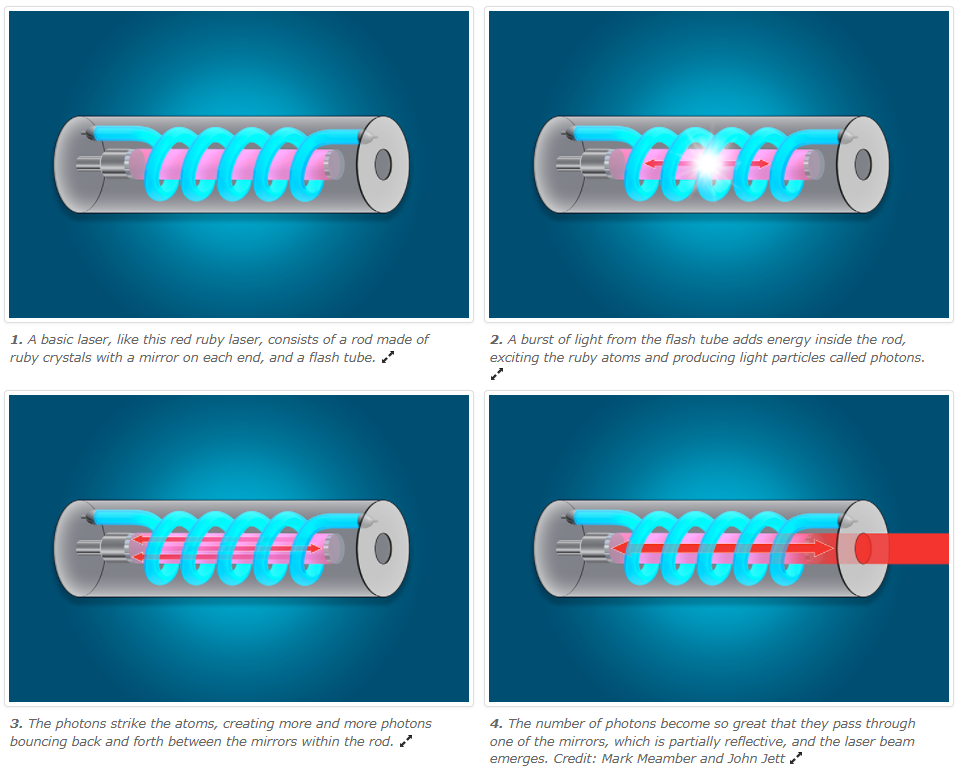
- A mirror on one side of the laser’s optical material bounces the photon back toward the electrons. The space between mirrors, or the “cavity,” is designed so the photon desired for the particular type of optical gain medium are fed back into the medium to stimulate the emission of an almost exact clone of that photon. They both move in the same direction and speed, to bounce off another mirror on the other side to repeat the cloning process.
- Two become four, four become eight and so on until the photons are amplified enough for them to all move past the mirrors and the optical material in perfect unison.
https://www.explainthatstuff.com/lasers.html
https://cirosantilli.com/condensed-matter-physics#laser