DRAKVUF writes breakpoint instructions into the guests’ memory at code-locations of interest. Since we will only get an event for precisely the code-location we are interested in this method effectively reduces the overhead.
However, the trade-off is that unlike EPT permissions the breakpoints are now visible to the guest. Thus, to hide the presence of the breakpoints from the guest, these pages need to get further protected by restricting the pages to be execute-only in the EPT. This allows DRAKVUF to remove the breakpoints before in-guest code-integrity checking mechanisms (like Windows Patchguard) can access the page.
using breakpoints presents a race-condition: the breakpoint hit by one vCPU has to be removed to allow the guest to execute the instruction that was originally overwritten, potentially allowing another vCPU to do so as well without notice.
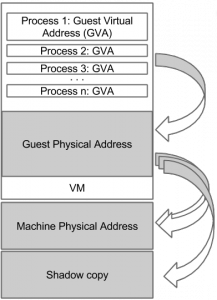
Fortunately, altp2m has another neat feature that can be used to solve this problem. Beside allowing for changing the memory permissions in the different altp2m views, it also allows to change the mapping itself! The same guest physical memory can be setup to be backed by different pages in the different views. With this feature we can really think of guest physical memory as “virtual”: where it is mapped really depends on which view the vCPU is running on.
Using this feature allows us to hide the presence of the breakpoints in a brand new way. To do this, first we create a complete shadow copy of the memory page where a breakpoint is going to be written and only write the breakpoint into this shadow copy. Now, using altp2m, we setup a view where the guest physical memory of the page gets mapped to our shadow copy. The guest continues to access its physical memory as before, but underneath it is now using the trapped shadow copy. When the breakpoint is hit, or if something is trying to scan the code, we simply switch the view to the unaltered view for the duration of a single-step, then switch back to the trapped view. This allows us to hide the presence of the breakpoints specific to each vCPU! All without having pause any of the other vCPUs or having to emulate. The first open-source implementation of this tracing has been already merged into the DRAKVUF Malware Analysis System and is available as a reference implementation for those interested in more details.
https://github.com/tklengyel/drakvuf/wiki/Xen-altp2m