Attachment Style Attachment is the persistent and emotionally significant affectional bond that individuals form with others.
- A person’s attachment style is their specific way of relating to others in relationships.
- Attachment style includes the way we respond emotionally to others as well as our behaviors and interactions with them
- There are four main adult attachment styles: secure, anxious, avoidant, and fearful-avoidant (aka disorganized). The latter three are all considered forms of insecure attachment.
- It must be kept in mind that one may exhibit different attachment styles in different relationships.
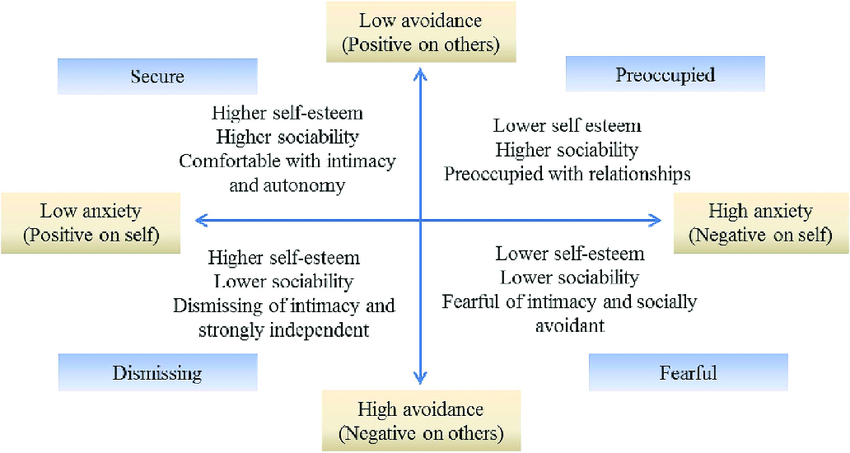
One’s attachment style develops in the first interactions with significant others during infancy and childhood, and subsequently guides stable predictions about future interpersonal and sexual interactions and instances of possible rejection.
There are various ways to classify attachment styles based on the distinction between secure and insecure attachment. A widely used instrument to assess five dimensions of attachment is the Attachment Styles Questionnaire (ASQ).
This questionnaire assesses five dimensions of attachment that can be combined into three attachment styles: Secure Attachment (consisting of the Confidence in Relationships dimension), Avoidant Attachment (consisting of the Discomfort with Closeness and Relationships as Secondary dimensions), and Anxious Attachment (Need for Approval and Preoccupation dimensions).
[ Hazan C, Zeifman D, Middleton K] Adult romantic attachment, affection, and sex.
-
Secure Attachment is related to experiencing pleasure in a variety of sexual behaviors and openness to exploration in terms of sexual behavior.
- In addition, securely attached people are more likely to give a partner control during sexual intercourse, as they are more comfortable and experienced with relationships involving mutual trust and has been shown to be negatively associated with engaging in sex to please one’s partner, thereby reducing insecurity.
-
Anxious attachment style is a form of insecure attachment style marked by a deep fear of abandonment. Anxiously attached people tend to be very insecure about their relationships
- Anxious attachment is associated with “neediness” or clingy behavior,
-
Avoidant attachment style is a form of insecure attachment style marked by a fear of intimacy.
- People with avoidant attachment style tend to have trouble getting close to others or trusting others in relationships, and relationships can make them feel suffocated.
Critical Evaluation
A study conducted on young adults revealed that participants possessed distinct attachment patterns for different relationship types (parent-participant, friendship, and romantic relationship) and did not experience one “general attachment orientation,” except for some overlap in anxiety experienced in both friendship and romantic relationships.
Such empirical evidence serves as a reminder that attachment style may be context-specific and that one should not regard results from any assessments as the sole indicator of one’s attachment style.
Baldwin and Fehr (1995) found that 30% of adults changed their attachment style ratings within a short period of time (ranging from one week to several months), with those who originally self-identified as anxious-ambivalent being the most prone to change.
https://onlinelibrary.wiley.com/doi/abs/10.1111/j.1475-6811.1995.tb00090.x