The five-factor model of personality (FFM) is a set of five broad trait dimensions or domains, often referred to as the “Big Five”:
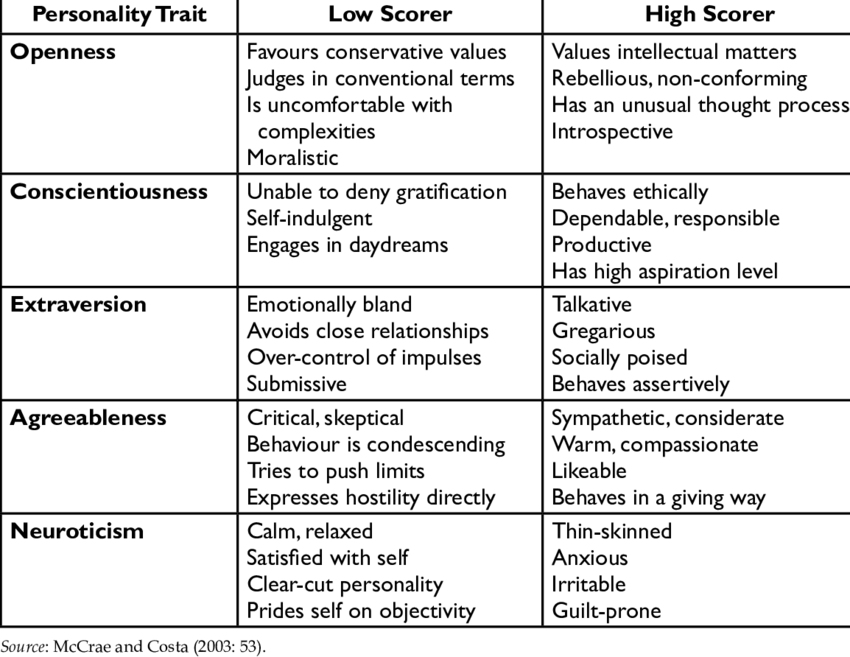
- Highly Extraverted individuals are assertive and sociable, rather than quiet and reserved.
- Agreeable individuals are cooperative and polite, rather than antagonistic and rude.
- Conscientious individuals are task focused and orderly, rather than distractible and disorganized.
- Neurotic individuals are prone to experiencing negative emotions, such as anxiety, depression, and irritation, rather than being emotionally resilient.
- Highly open individuals have a broad rather than narrow range of interests, are sensitive rather than indifferent to art and beauty, and prefer novelty to routine.
The Big Five/FFM was developed to represent as much of the variability in individuals’ personalities as possible, using only a small set of trait dimensions. Many personality psychologists agree that its five domains capture the most important, basic individual differences in personality traits and that many alternative trait models can be conceptualized in terms of the Big Five/FFM structure
https://www.oxfordbibliographies.com/view/document/obo-9780199828340/obo-9780199828340-0120.xml