http://k-punk.abstractdynamics.org/
It is easier to imagine and end to the world than an end to capitalism.
https://www.youtube.com/watch?v=3IXvaFCauLw
https://www.youtube.com/watch?v=6Cb5XJH4NMI
“Capitalism Realism” describes the widespread sense that the only viable political econimic way to organize society is through capitalism. People are literally unable to imagine any other coherent way of organizing society. Capitalism is somethin resembling more a fluid than a monolithic structure, its plasticity is astonishing.
“Deleuze and Guattari describe capitalism as a kind of dark potentiality which haunted all previous social systems. Capital, they argue, is the ‘unnamable Thing’, the abomination, which primitive and feudal societies ‘warded off in advance’. When it actually arrives, capitalism brings with it a massive desacralization of culture. It is a system which is no longer governed by any transcendent Law; on the contrary, it dismantles all such codes, only to re-install them on an ad hoc basis.”
Capitalism is a monstrous, infinitely plastic entity, capable of metabolizing and absorbing anything with which it comes into contact.
We’ve lost our ego in the postmodern age due to the schizophrenic nature of capitalism.
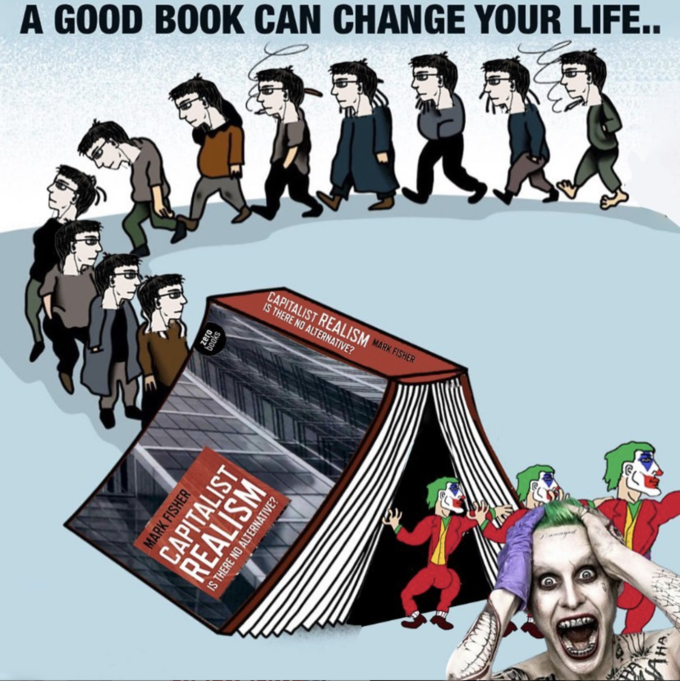

We no longer unify, we’re fragmented. Due to the opening up of the ego we experience time differently. This breakdown in signifiers reduces us to the present moment.
**If we are unable to unify the past, present, and future of the sentence, then we are similarly unable to unify the past, present, and future of our own biographical experience of life. We are reduces to an experience of pure mateiral signifiers, or a series of pure and unrelated presence in time **
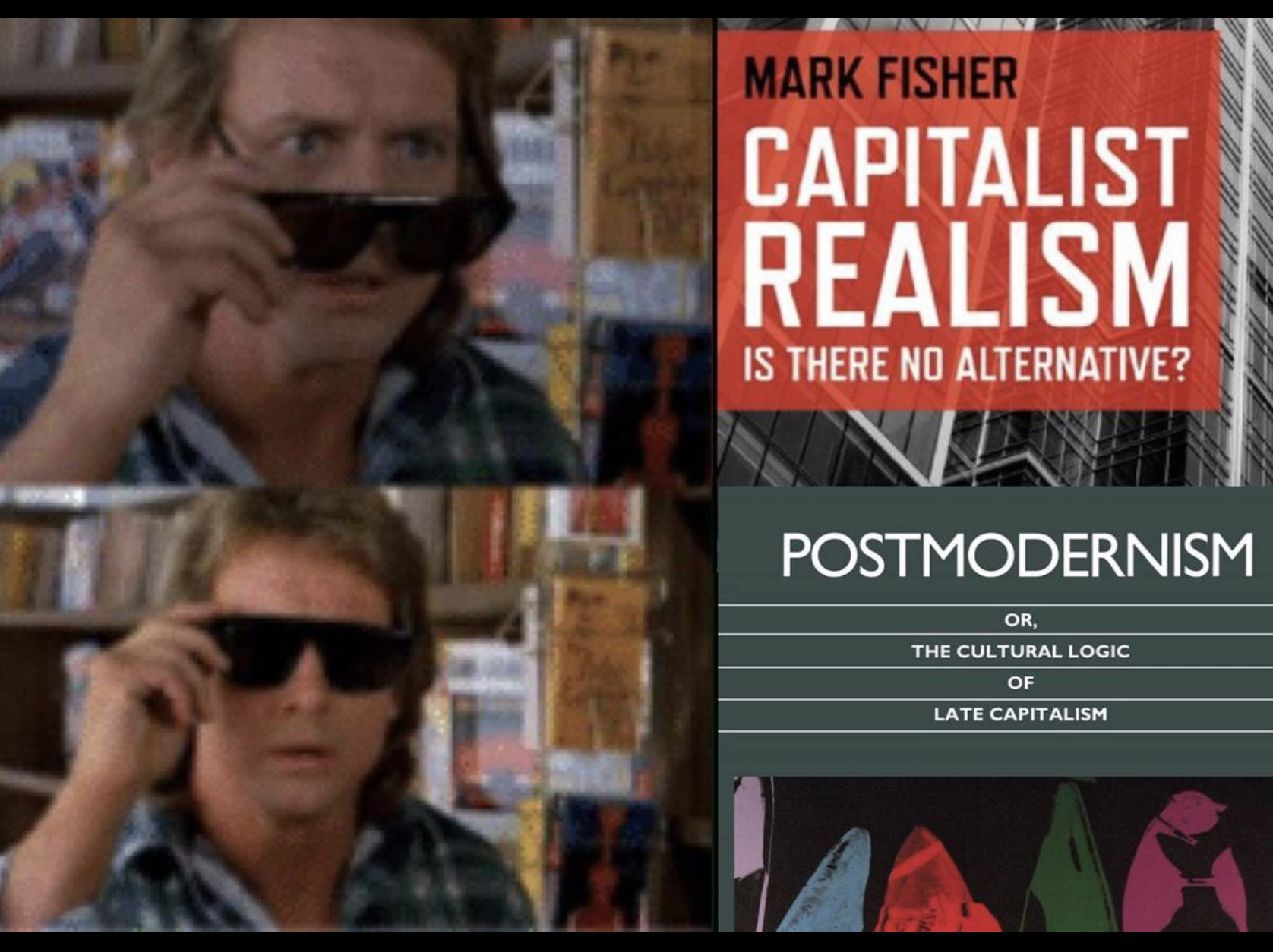
“For most people capitalism occupies the horizons of what is thinkable, it has seeped into our unconscious.
Capitalism triggers certain mental illnesses:
“If it is true, for instance, that depression is constituted by low serotonin levels, what still needs to be explained is why particular individuals have low levels of serotonin. This requires a social and political explanation”.
As Michel Foucault demonstrated, capitalism does not reproduce the Middle Age’s scheme of sovereignty, based principally on a continuous state of war, that was considering human lives as a consumable good by the transcendental power. Instead of that, capitalism manages and control lives in order to maintain an extraction of work production on a continuous basis.
https://thefunambulist.net/editorials/philosophy-a-thousand-machines-by-gerald-raunig
implications of being terminally online in a confusing, almost pathologized, schizophrenic state. In the era of post-truth and continuous crises, ironic expression is nearly indistinguishable from sincere belief. Nothing means what it says. Everything is interpretive evasion.
https://donotresearch.substack.com/p/welcome-_-take-a-seat-wherever
We are in a generation raised entirely on the exponent: schooled by the internet, fuelled by Adderall and stimulants, gathered through server platforms, texting in hyper-referentiality.
Yet, we shoulder spectres of late-capitalism, fallen idealisms, and carry the load of an ecological malaise. When the cloud has become the new infinite resource, when data capitalism encroaches upon emotionality; our feelings mined, extracted, commodified. In a manic attempt to cope, we embrace irony to shelter ourselves from a demoralising reality. We gaslight ourselves into contentment with disingenuous, dissociative modes of consumption. We try to disavow meaning, or feign meaning out of the absurd. Because somehow it is still easier to imagine an end to the world than an end to capitalism. The memetically referential title lends the show its contextual chaos. While cringevibing, an oxymoron composite of two neologisms, signals an action to embrace the absurd and our disgust.
“Capitalism has defined ‘health’ itself as a capacity to submit oneself to labor.”
― Beatrice Adler-Bolton & Artie Vierkant, Health Communism
I’m 38 years old and I just had to ask my mom if I could borrow money. Writing that email was enough to send me into a sobbing panic spiral about potentially spending the next 50 years without stable income. (…) There’s a strange grief in no longer being economically useful.
We’ve been using our productivity as proof of our worth for too long now. I don’t think it’s accidental that so many of us experience unemployment or disability as a kind of moral failure.
Much of modern Western culture, particularly in the United States, was shaped by what sociologist Max Weber called the Protestant work ethic: the belief that hard work, discipline, frugality, and productivity were signs of virtue.
When you become chronically ill or disabled, you begin to understand how deeply this ideology has embedded itself into the psyche. The shame of no longer being able to work consistently feels personal. As though my body’s inability to keep pace with capitalism says something fundamental about who I am.
im-38-and-i-cant-support-myself-anymore